
MD&M Midwest 2026 Recap: What the DISHER Team Took Away from Minneapolis
Nov 10, 2026 | 2 min read
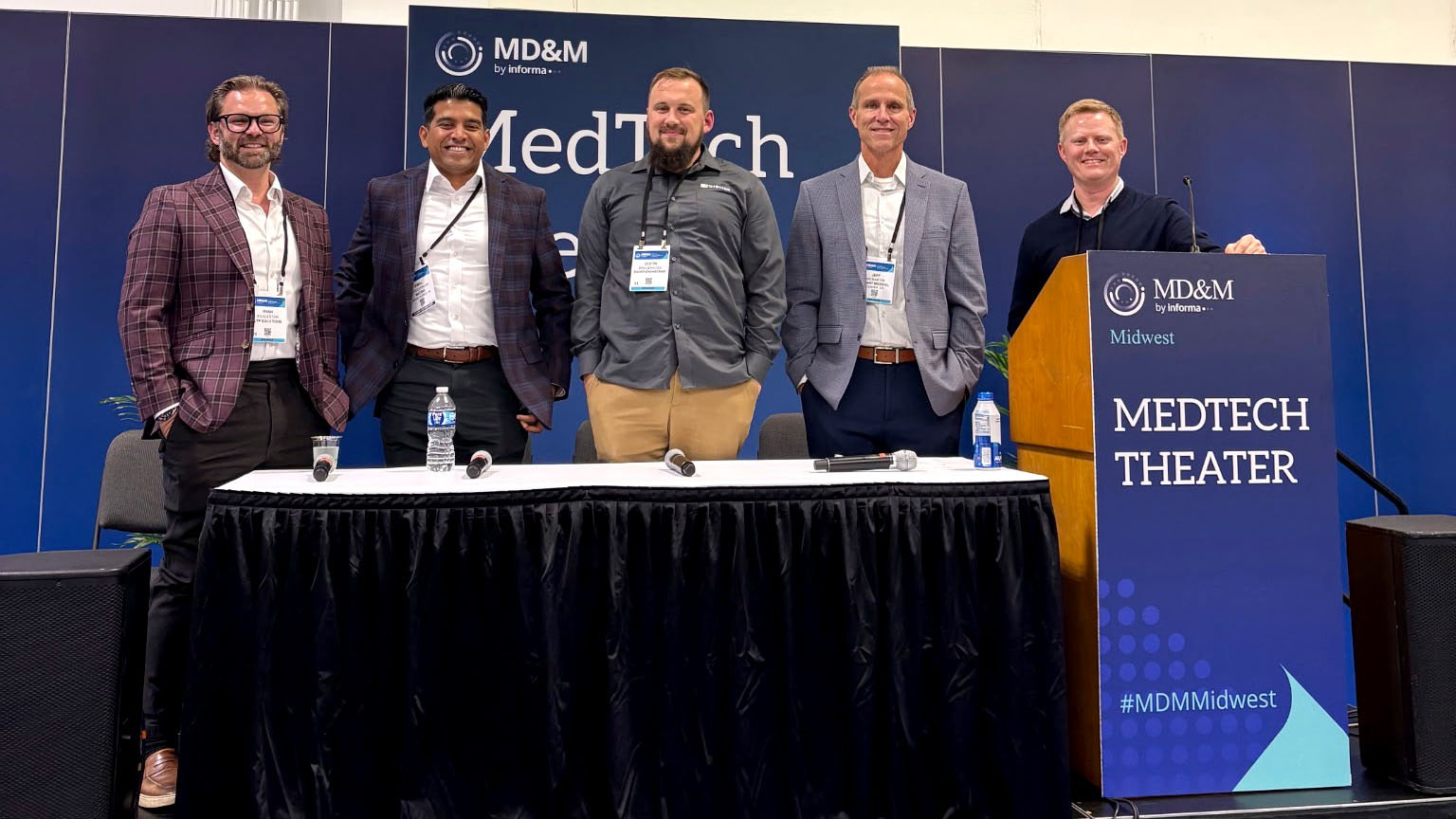
MD&M Midwest 2026 ran October 28 to 29 at the Minneapolis Convention Center, and the DISHER team came home with one clear message from the medical device community: the hardest problems start with understanding the end user, and the best fixes happen early.
On Wednesday, October 28, Tim Ullrey, Engineering Manager at DISHER, facilitated a medical device design panel in the show’s MedTech Theater. The panelists were Jeff McMartin of Pliant Medical, Ryan Eggleston of UTP Solutions, Vimal Venugopalan of Medbio, and Justin DeKoekkoek, Project Engineer III at DISHER.
Justin brings more than 15 years of engineering and project management experience, mostly in the medical device industry. Here is what the team heard from the stage and on the show floor.
Key Takeaways
- The biggest gap the panel discussed was understanding and documenting what end users need.
- Design changes made early have minimal impact. Once molds are cut and qualified, the same change carries significant time and cost impacts.
- Attendees asked about Design for Automation, a topic that matters most for high-volume medical device programs.
- Companies on the show floor showed interest in focusing on their core competencies and partnering with experts for the rest.
What was the MD&M panel about?
The panel looked at the gap between what users need and what can be built at scale. Panelists came at that question from different points in the medical device supply chain, which gave the discussion range.
The gap that came up most was understanding and documenting end users’ needs. The moments that landed hardest were the stories. Panelists described projects where miscommunication or a misunderstanding about the user led to an error, and what each team learned from it.
Why do early design decisions matter so much in molded medical devices?
The molding perspective on the panel made the cost of timing concrete. Changes discussed and made early in a program have minimal impact. Changes caught only after molds are cut and qualified carry significant time and cost impacts.
That is the case for design for manufacturing and assembly. DISHER’s design engineering team describes the goal as “designing products that are simple, fast, and cost-effective to build right from the start.”
What were medical device teams asking about?
Questions from the audience centered on Design for Automation, a term the panelists used for designing parts with large-scale molding in mind. The team saw it as a critical conversation for high-volume programs.
What stood out on the show floor?
In conversations with companies at the show, the team noticed a clear interest in vendors sticking to their core competencies. Instead of doing everything in-house, companies are partnering with other vendors to create higher-value products and processes.
That fits how DISHER works. Our product development team offers integrated design and engineering “from concept through production.” On a medical powered stair chair program, for example, DISHER’s cross-functional team worked alongside the client’s electrical and mechanical engineers.
Why does DISHER show up at MD&M Midwest in person?
A trade show gives the team a chance to show its capability and its availability to meet customers’ needs, face to face. A call or an email can describe what DISHER does. A conversation on the show floor lets people see how the team thinks.
What advice does the team have for a new medical device design project?
Start by naming your core objective and what falls outside it. Then find an expert partner to handle the portions of the process outside your core. Throughout the project, communicate and document the end user’s needs, and keep them at the center of every decision.
Our post on human factors in medical device design goes deeper on why understanding the user early pays off.
Planning a medical device project? Start a conversation with our team.
Frequently Asked Questions
The show returns October 26 to 28, 2027, at the Minneapolis Convention Center, according to the MD&M Midwest website.
Yes. Beyond the stair chair program above, DISHER traced a defect that kept recurring at one station of a medical equipment production line back to its source and fixed it there.
Written By:

DISHER
Communications Team
DISHER Newsletter
Sign up to receive articles and insights, delivered monthly.
Schedule a no-committment project call
Reach out to discuss your project to find out if DISHER could be a good fit for you.