
What is a CIP System? Food and Beverage Manufacturing Terms Explained
Aug 18, 2026 | 2 min read
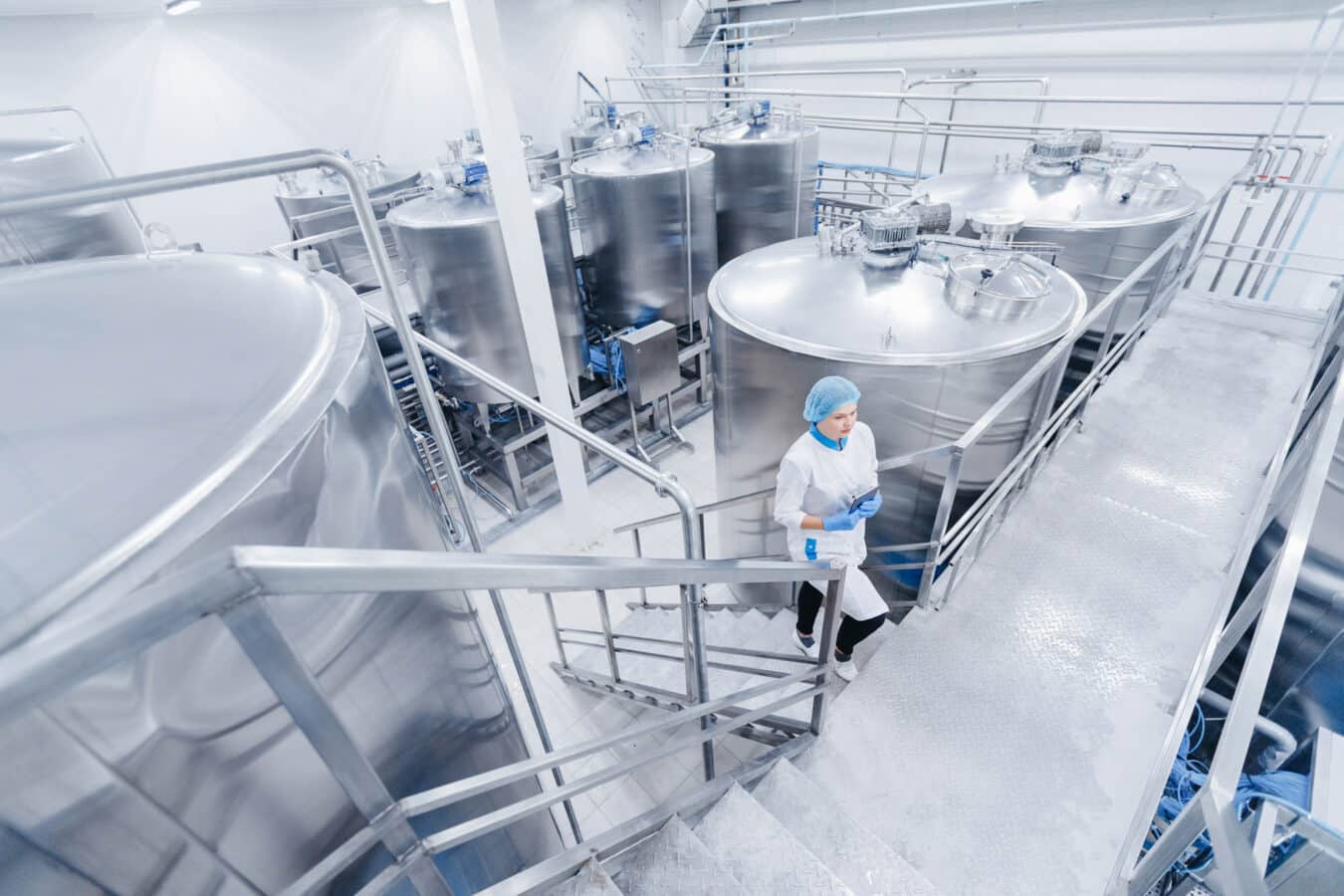
Walk into a food or beverage manufacturing facility and you’ll hear a specific vocabulary: CIP, COP, SIP, skids, TACT parameters, single-use systems, reuse loops. These aren’t interchangeable shorthand. Each term describes something precise about how a plant cleans its equipment, controls contamination, and keeps lines running.
For engineers new to food and beverage manufacturing, or those crossing over from other industries, getting the terminology right is the first step to understanding how these systems actually work. This article covers the essential terms and how they relate to each other.
Key Takeaways
- CIP (clean-in-place) is the automated cleaning of processing equipment without disassembly, using circulated water, chemicals, and heat.
- Four variables control CIP effectiveness: Time, Action (flow), Concentration, and Temperature, commonly called TACT.
- CIP processes range from 1-step (hot water rinse) to 7-step (full chemical plus sanitizer cycles), depending on industry and soil type.
- COP (clean-out-of-place) handles components that must be disassembled to clean. Most facilities use both CIP and COP.
- SIP (sterilize-in-place) adds a steam-based sterilization step to the CIP circuit for applications requiring higher microbial control.
- CIP frequency varies significantly by industry: dairy facilities clean every 24 to 48 hours; beverage facilities every one to three days; food processing every several days to a week.
What Is a CIP System?
CIP stands for clean-in-place. A CIP system cleans the interior surfaces of processing equipment, including pipes, tanks, vessels, heat exchangers, and filling lines, without disassembling any of it. Cleaning solutions are pumped through the same piping paths as the product, removing residue from every internal surface.
The alternative is taking equipment apart, transporting components to a cleaning station, scrubbing them manually or in a machine, and reassembling the line. For a 10,000-gallon tank or a continuous piping network, that approach isn’t practical. CIP makes it possible to clean large, interconnected systems in place, with the cleaning cycle automated and the critical parameters monitored in real time.
CIP is the standard cleaning method in food and beverage, dairy, brewing, pharmaceutical, and personal care manufacturing. The specifics, including cycle length, chemical choice, and number of steps, vary by industry and product type, but the basic principle is the same across all of them.
The Four Variables That Control CIP Effectiveness: TACT
Every CIP cycle is governed by four parameters. The industry shorthand for these is TACT.
Time refers to the duration of each cleaning phase. Longer contact time improves cleaning effectiveness, particularly for stubborn or heat-set soils. The right duration depends on the soil type and the chemicals being used.
Action refers to turbulent flow, meaning the mechanical force of the solution moving through the equipment. Velocity matters: target flow rates in piping are typically 1.5 to 2.1 meters per second, which creates the turbulence needed to dislodge residue from surfaces. Too slow, and the chemistry alone won’t do the job.
Concentration refers to the percentage of chemical in the cleaning solution. Caustic is typically run at 1 to 4% concentration; acid at 0.5 to 1.5%. Concentration outside the target range, whether too low or too high, produces ineffective cleaning or excessive chemical cost.
Temperature refers to the solution temperature during each phase. Caustic is typically run hot, between 65°C and 80°C. Higher temperature accelerates cleaning action and helps dissolve soils that resist lower-temperature washes. Acid and sanitizer steps are often run cooler.
These four variables interact. A facility can compensate for a shorter contact time with higher temperature, or for lower chemical concentration with extended exposure. Understanding these tradeoffs is where CIP optimization happens.
CIP Process Types: 1-Step Through 7-Step
CIP programs are defined by the number of steps in the cleaning sequence. More steps provide more thorough cleaning and cover a wider range of soil types, but also add time, complexity, and resource consumption. The right process depends on the product being cleaned, the industry’s regulatory requirements, and the facility’s risk tolerance.
1-Step CIP
Uses a hot water flush to disinfect and kill bacteria. It’s most common in personal care and home products manufacturing, where hygiene requirements are lower than in food production.
3-Step CIP
Adds a single chemical phase, either caustic or acid, between water rinses. The sequence is: pre-rinse, chemical wash, final rinse. Three-step is standard in beverage and food manufacturing for moderate soil loads and compatible product changeovers.
5-Step CIP
Introduces a second chemical phase and an intermediate rinse to separate the two chemical steps. A typical sequence: pre-rinse, caustic, intermediate rinse, acid, final rinse. The caustic removes organic soils; the acid removes mineral scale and deposits left by repeated caustic washes. Five-step is where most food and beverage facilities land. It covers the full range of common soils without the extended cycle time of a 7-step program.
7-Step CIP
Adds a dedicated sanitizer step and additional intermediate rinses for the highest level of microbial control. Common in dairy and pharmaceutical manufacturing, where regulatory requirements and contamination consequences make shorter cycles unacceptable. A typical sequence: pre-rinse, caustic, intermediate rinse, acid, intermediate rinse, sanitizer, final rinse.
The step count is a risk decision. Seven-step programs run in dairy because the cost of contamination (product recalls, facility shutdowns, pathogen exposure) far outweighs the cost of extended downtime. Facilities should periodically verify that the program running on their line reflects their actual soil conditions, not a worst-case program set up years ago and never revisited.
CIP Chemicals: Caustic, Acid, and Sanitizer
Three chemicals do the work in most CIP cycles.
Caustic (sodium hydroxide, NaOH) is the heavy lifter. It’s a high-pH solution that breaks down organic soils including fats, proteins, and starches through saponification. Caustic is almost always run hot, typically at 65°C to 80°C, because heat significantly increases cleaning action on organic residue. The tradeoff is that high-pH caustic washes accelerate calcium carbonate buildup and mineral scale over time, which is why most facilities follow caustic with an acid step.
Acid (nitric, phosphoric, or citric acid) removes mineral scale and deposits that caustic leaves behind or can’t touch. It also handles soils that are mineral-based in origin. The type of acid matters: nitric acid is the most common in food and beverage manufacturing, aggressive on scale and widely available; phosphoric acid is gentler and used where nitric is too harsh; citric acid is used where a more environmentally favorable option is needed, though it’s less effective on heavy buildup.
Sanitizer (peracetic acid, PAA) is the final kill step. PAA is a broad-spectrum antimicrobial that eliminates bacteria, yeast, mold, and viruses that survive the wash phases. It breaks down into water and acetic acid, making it food-safe with no rinse required in many applications. PAA is typically run cold, at low concentrations of 100 to 200 ppm, with short contact times of a few minutes. Some facilities substitute a hot water step at 82°C or higher for the sanitizer phase, though this uses significantly more energy.
CIP vs. COP: What’s the Difference?
COP stands for clean-out-of-place. Where CIP cleans equipment in its assembled state using circulated solution, COP requires disassembling components and cleaning them separately, in a parts washer, by hand, or in a dedicated cleaning machine.
COP applies to components where CIP flow can’t reach effectively: fittings, gaskets, spray balls, hoses, valves, and small parts that trap residue in their geometry. A piping network can be cleaned in place; the individual fittings connecting that piping may need to come apart for effective cleaning.
Most facilities use CIP and COP together. The sequence matters: operators disassemble the components that require COP, prep the line for CIP, and run both processes simultaneously. The line can’t return to production until both are complete. Facilities that map out which step takes longer, CIP or COP, often find that one is consistently holding up the other, and that addressing the bottleneck recovers meaningful production time.
What Is SIP?
SIP stands for sterilize-in-place. Where CIP removes residues and contaminants through chemical cleaning, SIP sterilizes the equipment through the same assembled circuit using saturated steam or hot water at temperatures above 121°C.
SIP is used in applications where the standard CIP sanitation step isn’t sufficient, primarily pharmaceutical manufacturing and some food applications where sterility, rather than sanitation, is the requirement. The key distinction is that sanitization reduces the microbial load to a safe level; sterilization eliminates it.
In facilities that use both, SIP typically follows a completed CIP cycle, using the same piping circuit but operating at higher temperatures than CIP equipment is often designed to handle continuously. Not all CIP systems are configured to support SIP, and the distinction matters during equipment selection for new lines.
CIP System Components: What’s in a Skid
A CIP skid, also called a CIP station or CIP system, is the self-contained unit that stores, heats, and circulates cleaning solutions through the processing equipment. Every CIP skid, from a compact single-tank unit to a large multi-loop central system, includes the same core components.
Solution tanks store the water and chemical solutions used in each cleaning phase. Larger systems have dedicated tanks for water, caustic, and acid, with chemicals reclaimed and recirculated between cycles. Smaller systems may use a single tank and prepare fresh solution for each run.
Pumps circulate the solution through the equipment at the velocity required for effective cleaning. Pump sizing is critical: too small, and the system won’t achieve the flow rate needed for turbulent cleaning. Centrifugal pumps are standard.
Heat exchangers bring the solution to target temperature before it enters the equipment. For caustic phases running at 65°C to 80°C, heat exchangers are the mechanism that makes those temperatures achievable without overheating the entire tank.
Instrumentation monitors conductivity, temperature, and flow rate throughout each phase. Conductivity sensors confirm chemical concentration is within the target range. Temperature sensors verify the solution is at the right temperature when it contacts equipment surfaces. Flow meters confirm the velocity needed for turbulent cleaning is being achieved.
Piping and valves control which equipment is connected to the cleaning circuit during each phase, and direct solution through the correct flow paths. In multi-loop systems, valve sequencing determines which lines run simultaneously and in what order.
Single-Use vs. Reuse CIP Systems
CIP systems fall into two categories based on how they handle chemicals after each cycle.
Single-Use (Type I) systems prepare fresh chemical solution for each CIP cycle and discharge the spent solution to drain when cleaning is complete. Nothing is reclaimed. Type I skids are typically smaller, simpler, and require lower upfront capital investment. They’re more common in smaller operations and older facilities. The operating cost is higher because chemicals are purchased and discarded with every cycle.
Reuse (Type II) systems store chemical solution in a dedicated holding tank and recirculate it across multiple cleaning cycles. As the solution weakens, it’s re-dosed to restore concentration. When tank volume drops below a threshold, fresh solution is prepared and added. Type II systems require larger capital investment and additional tank capacity, but significantly reduce chemical consumption over time. They’re most common in larger, newer facilities where the operating savings justify the upfront cost.
CIP Across Industries: How Frequency and Complexity Vary
The CIP program running in a dairy facility looks different from the one in a beverage plant, which looks different again from a brewing operation. The differences are driven by regulatory requirements, soil characteristics, and the consequences of contamination.
Dairy
Runs CIP most frequently in food manufacturing, every 24 to 48 hours, with 5-step or 7-step programs standard. The combination of milk proteins, fats, and heat-set soils from pasteurization demands both caustic and acid phases. Contamination consequences in dairy are severe, which drives the industry toward the most thorough programs.
Beverage
Facilities clean every one to three days, with 3-step programs standard for most products and 5-step for stickier formulations. The primary soils are sugar residue and flavor compounds. CIP frequency increases during high-changeover periods when multiple incompatible products run on the same line.
Brewing
Combines high-changeover beverage production with the protein and yeast residues that come from fermentation. Five-step programs are common: caustic removes yeast and proteins, and the acid step addresses the calcium carbonate scale that accumulates from repeated high-pH caustic washes. Scale buildup, sometimes called beerstone, is a persistent challenge in brewing CIP.
Food processing
Covers the widest range of products and soil types. Sauces, soups, condiments, and ready meals all present different cleaning challenges. CIP frequency may stretch to several days or a week between scheduled cleans, though product changeovers between incompatible formulations trigger additional cycles. Five-step programs are common; facilities running high-fat or high-protein products often extend caustic contact time.
Pharmaceutical manufacturing
Adds a compliance dimension absent in food and beverage. Every CIP cycle must be validated, documented, and audit-ready. The cleaning validation process demonstrates that cycles consistently reduce active pharmaceutical ingredient (API) carryover to acceptable levels. Documentation and traceability carry equal weight to cleaning efficacy in pharma CIP.
Key Terms at a Glance
CIP (Clean-in-Place): Automated cleaning of assembled processing equipment using circulated water, chemicals, and heat.
COP (Clean-out-of-place): Cleaning method requiring disassembly of components for separate cleaning, typically fittings, gaskets, and small parts.
SIP (Sterilize-in-Place): Sterilization of assembled equipment using saturated steam or high-temperature hot water at temperatures above 121°C, run through the same circuit as CIP.
CIP Skid: The self-contained unit housing the tanks, pumps, heat exchangers, and instrumentation that run a CIP system.
TACT: The four variables governing CIP effectiveness: Time, Action (flow/turbulence), Concentration, and Temperature.
Caustic: Sodium hydroxide (NaOH) solution used in CIP to break down organic soils including fats and proteins.
Acid: Nitric, phosphoric, or citric acid solution used in CIP to remove mineral scale and deposits.
Sanitizer (PAA): Peracetic acid solution used as a final kill step to eliminate bacteria, yeast, mold, and viruses.
Type I (Single-Use) System: CIP system that prepares fresh chemical solution each cycle and discharges spent solution to drain.
Type II (Reuse) System: CIP system that recirculates and reclaims chemical solution across multiple cycles.
Changeover Matrix: A facility document defining which type of cleaning, whether CIP, COP, product push, or water flush, is required when switching between any two products on a given line.
Where DISHER Engineering Can Help
CIP system design and integration is a process engineering challenge that touches equipment selection, piping layout, instrumentation, controls, and validation. Getting it right requires understanding not just what a CIP skid does, but how it fits into the full production system: line velocities, equipment geometry, product compatibility, and the regulatory requirements specific to the industry.
At DISHER Engineering, we work with food and beverage manufacturers on process design, manufacturing engineering, and capital project management. Whether you’re designing a new production line with CIP built in from the start, troubleshooting a cleaning program that isn’t meeting validation requirements, or expanding capacity in an existing facility, we can help you build a system that performs.
Written By:

DISHER
Communications Team
DISHER Newsletter
Sign up to receive articles and insights, delivered monthly.
Schedule a no-committment project call
Reach out to discuss your project to find out if DISHER could be a good fit for you.