
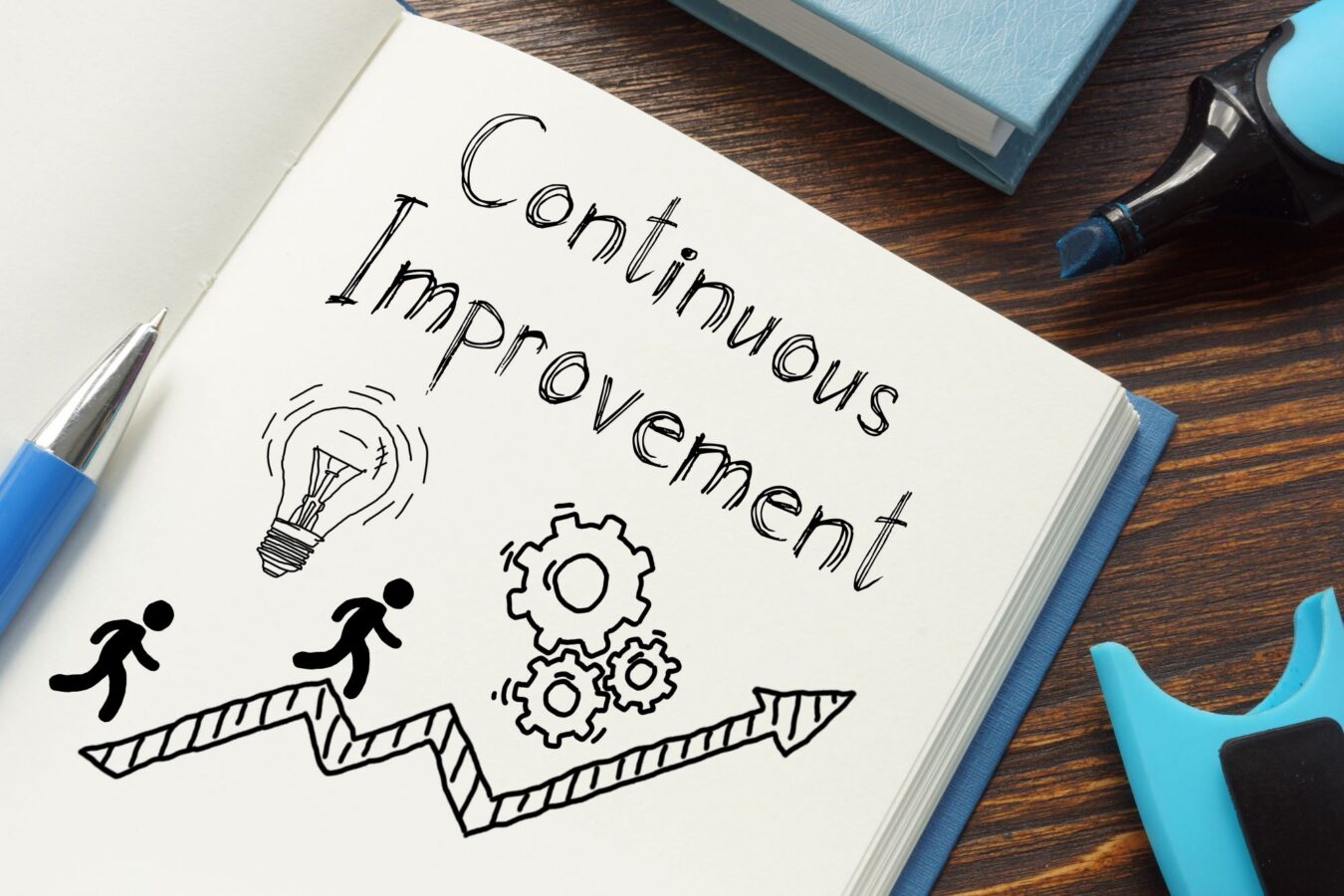
Building a continuous improvement (CI) culture — one where people look for problems, suggest better ways, and follow through — takes more than a methodology like Lean or Six Sigma. It takes intentional leadership, putting the right structures in place, and a team that believes their voices are heard and their input matters.
If your team isn’t there yet, that’s okay. Honestly, most aren’t. Continuous improvement is a journey that never ends, but it does have a beginning. Let’s look at what a continuous improvement culture really means, why so often our efforts fall short, and some practical steps we can take to make improvement part of how work gets done, not just something that happens before a periodic review or audit.
What Is a Continuous Improvement Culture?
A continuous improvement culture is a shared commitment at every level of an organization to consistently look for improvements to processes and systems within the business. As we noted earlier, continuous improvement is a never-ending journey, one with detours and breaks along the way. The focus should be on the journey and the people and processes involved.
Here are some ways this may show up in practice:
- Problems are brought to the surface quickly, without fear of judgement or penalty. When people can trust, they can feel free to talk and provide key insights.
- Improvement ideas come from people doing the work, not just leadership. The people closer to the process have the knowledge to improve the process. That weird noise every 10th part is valuable knowledge.
- Small, incremental changes are valued, not just breakthrough initiatives. What we measure, however small, is something we can control and improve upon.
- Teams measure outcomes and adjust based on what data shows. Let us leave our feelings at home for the day.
We want to be clear that building a culture is different from running a Lean event or Six Sigma project. Those are tools that typically have a start and end date. Culture is ongoing and what allows for those tools to provide value.
Past experience shows that working with engineering and manufacturing teams across industries, the companies that sustain improvement over time aren’t necessarily the ones with the most sophisticated methods. They’re the ones where CI is simply how they operate.
Why Most Continuous Improvement Efforts Stall
If a continuous improvement culture were easy to build, more companies would have it. Anything worth doing takes time and there are always roadblocks on the continuous improvement journey. Here are the most common themes below that typically get in the way of real improvement.
Leadership Doesn’t Model It
Teams take their cues from the top. If leadership talks about continuous improvement but never participates in improvement activities, never asks for ideas, and never acknowledges small wins, the message is clear: CI is something other people do.
Real CI culture starts when leaders demonstrate curiosity about their own processes, ask questions without blame, and visibly act on employee input. Without consistent leadership support, sustainable culture cannot establish and grow.
People Are Judged or Punished for Finding Problems
This one is subtle but destructive. When someone raises a quality issue and the immediate response is “How did this happen?” followed by a search for someone to blame, you’ve just taught your team to stay quiet next time.
Continuous improvement requires psychological safety — the belief that raising a problem won’t cost you. That takes a long time to build and unfortunately a very short time to destroy.
Improvement Ideas Go Nowhere
I’ve seen it so many times. A team submits a suggestion, nothing happens, no one follows up, and after a few rounds of this, people stop submitting ideas. Why bother?
If you want people to keep contributing, you need a system that closes the loop, even when the answer is “not right now.” Providing timely feedback that gives some justification on why it cannot happen right now goes a long way with keeping improvement ideas flowing.
Too Much Focus on Tools, Not Enough on People
Lean and Six Sigma are proven methodologies, but deploying a new tool without addressing the behavior, belief, and structure changes needed to support it is like installing a new piece of equipment without training the operators. The tools only work when the culture is ready to use them. Lean and Six Sigma tools identify, support, and measure improvement, but these tools are not “the improvement.” It is okay to modify a tool based on the needs of the people and the processes involved. Focusing on the people and their process knowledge is key to unlocking improvement and being able to sustain it.
5 Steps to Building a Continuous Improvement Culture That Sticks
1. Start with Leadership Alignment
Before you roll out any continuous improvement program, get your leadership team aligned on what CI means in your organization and what their role is in supporting it. It is not uncommon for a continuous improvement leader to take on the role of must helping everyone involved in the organization figure out what CI truly means to them.
This doesn’t mean reading a book about or sitting through a training course for Lean or Six Sigma. It means having honest conversations about current pain points, agreeing on what ‘good’ looks like, and commitment to modeling the behaviors we want to see in the organization.
Ask yourself: Do our managers know how to respond when someone brings them a problem? Do they listen, or do they react? Do they check in on improvement efforts, or does that fall off the calendar?
Outlining and defining expectations for leadership helps everyone involved understand the roles they will play within the continuous improvement of culture.
2. Make It Safe to Raise Problems
Psychological safety is the foundation of continuous improvement culture. Without it, you’ll get surface-level compliance and not much more.
Building safety takes a deliberate effort. Here are some starting points to try if your team is struggling with this:
- Separate problem identification with root cause analysis. First, acknowledge the issue, then dig into why. 5 Why is a great tool for this but it is not “the improvement”.
- When an employee brings you a problem, lead with curiosity instead of frustration. Problems always exist and that is the point of the words “continuous improvement”. If an employee brings up an issue or problem, it is because they are engaged and care. Their tone or tact may not always be the best but focus on nurturing those relationships.
- Conduct post-mortems with a ‘how do we improve the system’ focus, not a ‘who messed up’ focus. Avoid using “I” or “you” language. Focus on the “we” as we are indeed all one team trying to improve upon a problem.
Over time, these actions build the belief that improvement is welcome in your organization, and that belief is what drives CI behavior and fosters a growing continuous improvement culture.
3. Build Simple Systems for Capturing and Acting on Ideas
You don’t need an expensive software platform to capture improvement ideas. You need a system that works, meaning people know how to submit ideas, someone is accountable for reviewing them, and every idea gets a response.
Listed below are a few examples of what works:
- Visual CI boards (physical or digital) on the floor or in shared workspaces where anyone can add ideas. Physical often leads to the most engagement.
- Establish a schedule for reviewing and prioritizing ideas (weekly or biweekly works well for most teams) and stick to it.
- A simple status tracker that shows submitters where their idea stands.
- Leadership time set aside specifically to review and act on CI submissions.
The most important thing is closing the loop. Even a “we review this and here’s why we’re not doing it right now” response builds trust. Not giving consistent, timely feedback will ruin the continuous improvement culture we are trying to grow.
4. Measure What Matters and Share the Results
Continuous improvement culture is reinforced when people can see the impact of improvement efforts. That means measuring outcomes and communicating with the entire team, department, or organization.
Pick a small number of meaningful metrics tied to your biggest operational challenges. Some common metrics are:
- Cycle time reduction (how long does a key process take, and is it getting shorter?)
- First-pass yield or defect rate
- Number of improvement ideas submitted and implemented.
- Cost savings attributable to CI initiatives
- Employee participation rate in CI activities
We should use caution when setting goals specific tied to a required number of “improvements” per “some interval” or a cost savings target. It is true that organizations measure most activities and assign them a monetary value but requiring a cost savings of $50,000 or ten implemented improvements per quarter; this can lead to unintended consequences. These consequences can include forcing some ideas that are not fully implemented or inflating true cost savings. Continuous improvement and their activities should be organic and fluid in nature. If it feels forced, the outcomes will not sustain themselves.
5. Celebrate and Sustain
Momentum is especially fragile in the early stages of building a continuous improvement culture. Celebrating small wins is one of the most effective (and unfortunately underused) tools you have.
This doesn’t mean elaborate ceremonies, but it could mean:
- Calling out a team that solved a persistent quality issue in a morning standup meeting.
- Sharing a before-and-after improvement story in a company newsletter. A3 is a useful tool for displaying this.
- Publicly thanking the person who flagged a safety concern before it became an incident.
Recognition reinforces the behavior you want to see more of. It also signals to the rest of the organization that leadership takes CI seriously, which brings you back to Step 1.
The Specific Role Engineering Leadership Plays in Sustaining CI Culture
Frontline teams are the engine of continuous improvement. But engineering and operations leadership sets the conditions that determine whether that engine runs.
If you’re in an engineering leadership role, here’s what CI culture requires from you:
- Time on the floor (or in the process). You can’t spot improvement opportunities from a conference room.
- Talk to those closest to the process. Process operators, set-up technicians, and maintenance personnel often can tell you how things really operate.
- Honest assessment of current state. Not what you think or hope is happening, but what’s actually happening.
- Willingness to change your own processes first. CI is more credible when it starts at the top.
- Consistent follow-through on commitments. If you say you’ll review ideas by Friday, do it.
Observations in working with engineering teams across manufacturing, medical device, food and beverage, and other industries, the organizations that get CI culture right share one common trait: their leaders establish, communicate, and act in a manner that reinforces that improvement is part of everyone’s job.
Industry-specific Continuous Improvement Considerations
Continuous improvement culture can look a little different depending on your industry.
Medical Device
In highly regulated environments like medical device, CI has to work within compliance frameworks, which can slow things down if not managed well. The key is building improvement processes that document changes properly, involve QA early, and don’t inadvertently create compliance risk. CI and regulatory compliance aren’t completely at odds, but they do need to be deliberately aligned.
Are you set up for a smooth medical device development process? Find out here >>
Food & Beverage
In food and beverage manufacturing, CI initiatives often focus on yield improvement, waste reduction, and throughput. The challenge here is often shift-to-shift consistency and building CI habits across different crews and production schedules. Visual management tools and strong shift handoff practices are especially important.
Automotive Manufacturing
For automotive manufacturing, continuous improvement is a must. Tiered suppliers to automotive companies are consistently asked for price downs, and CI is where you can find the savings. CI culture often starts on the production floor and needs to work its way into engineering and support functions. Getting cross-functional teams involved early accelerates adoption and leads to better solutions.
Building a Continuous Improvement Culture Takes Time. Starting Is the Hardest Part.
There’s not really a shortcut to building a continuous improvement culture. It takes consistent effort, patient leadership, and a willingness to address the people and process challenges honestly.
But the payoff is worth it. Teams that operate with a CI mindset are more open-minded and curious. All team members communicate freely and pivot more easily in response to new data. We then can operate more efficiently and thus become more resilient during periods of change. A CI mindset allows us to catch problems earlier, solve them faster, and keep getting better over time.
If you’re trying to build that kind of culture, or you’ve got the right intent, but you’re stuck, our team at DISHER Engineering has helped engineering and manufacturing teams across dozens of industries work through these challenges. We’d be happy to talk about what’s working, what isn’t, and where your biggest opportunities are. Contact us online to get started.
Written By:

Jason Garland
Manufacturing Engineer
DISHER Newsletter
Sign up to receive articles and insights, delivered monthly.
Schedule a no-committment project call
Reach out to discuss your project to find out if DISHER could be a good fit for you.