

Coming up with a great idea is the fun part. The hard part? Figuring out how to turn that idea into a real product.
Most entrepreneurs and innovators struggle with the same challenge: they have a vision, but they’re not sure where to start or what to focus on. Without a structured approach, it’s easy to miss critical gaps, whether that’s understanding what customers actually want, figuring out if your product is feasible to build, or determining if there’s a viable business model behind it.
That’s where a product strategy framework comes in. We’ve developed a framework that guides you through evaluating 8 key areas of your product idea. This systematic approach helps you ask the right questions, identify blind spots in your thinking, and build a concrete action plan to move forward with confidence.
By working through this framework, you’ll accomplish three critical things: First, you’ll gain clarity on where your idea stands today and what’s still uncertain. Second, you’ll find alignment across all the moving parts of your product, from design and functionality to cost and sustainability. Third, you’ll build the early confidence you need to kick off your product development process knowing you’ve thought through the major considerations.
Whether you’re just starting to explore an idea or refining something further along, this framework will help you think critically and practically about the key areas that determine whether your product will succeed.
How to Utilize this Framework
As you go through each of the 8 areas, we’ve found it useful to split each category into three sections:
Current Concept – Capture the ideas you have right now. This lets you take stock of where you currently stand.
Ideas – Next, capture new ideas or half-baked thoughts. This gives you space to think differently and compare against your current concept.
Unknowns / Risks – Begin documenting the unknowns or risks for each section. Maybe it’s uncertainty about the cost of a specific material, or an unknown about safety regulations.
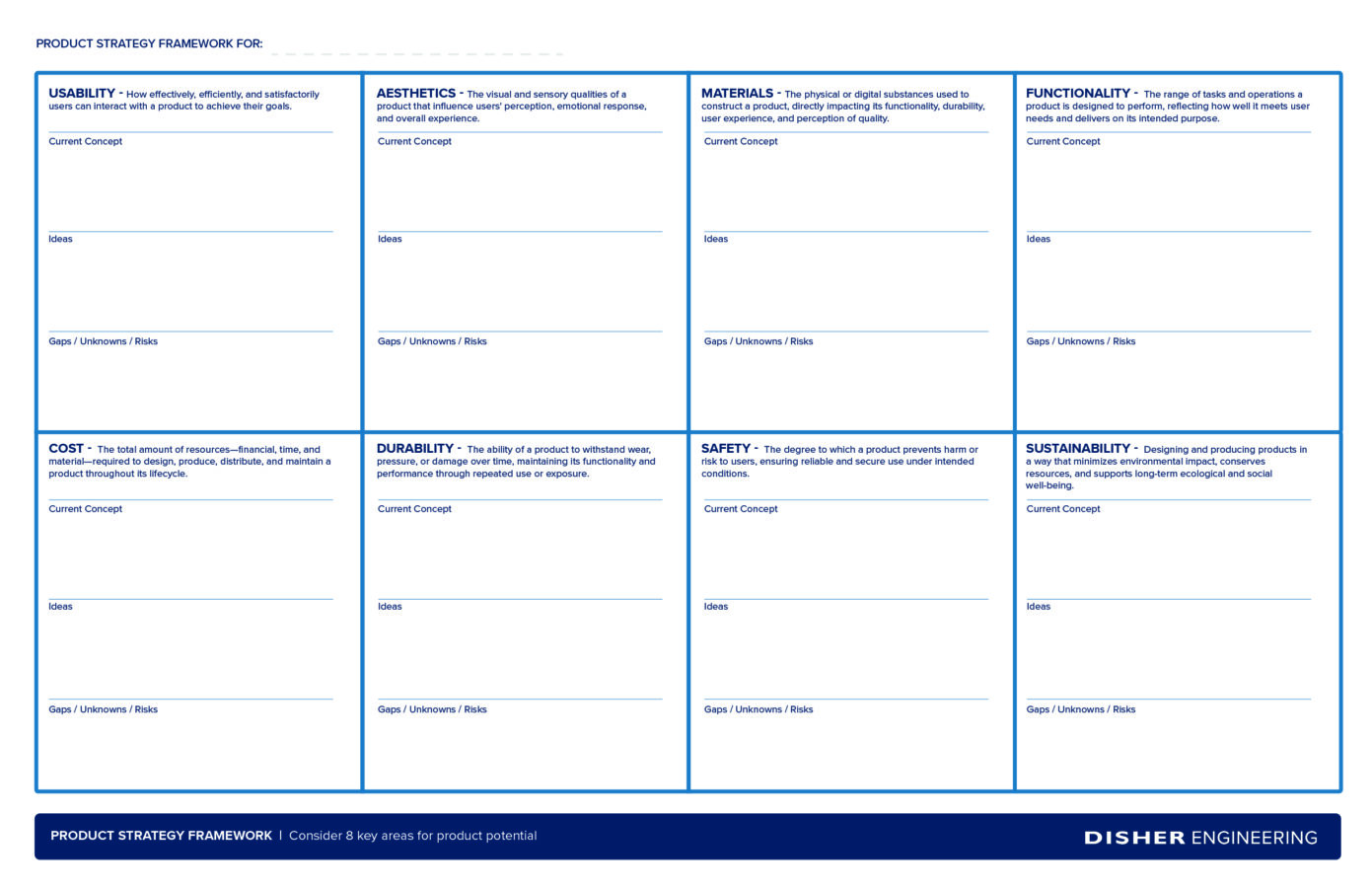
The 8 Areas of our Product Strategy Framework
Usability
Usability is all about how effectively, efficiently, and satisfactorily users can interact with a product to achieve their goals. When evaluating, ask yourself: What makes my product enjoyable to use? How does someone feel when they use it? Why would somebody want to buy my product?
Aesthetics
Aesthetics are the visual and sensory qualities of a product that influence users’ perception, emotional response, and overall experience. Do you want a sleek, minimal look, or should it feel colorful, soft, and whimsical? Your product’s design should match your intended vision.
Materials
The materials for your product are the physical or digital substances used to construct a product, directly impacting its functionality, durability, user experience, and perception of quality. If it’s food-based, does it need food-grade materials? Does it need heat resistance? Will it be outdoors where colors might fade? These are all questions you need to ask when selecting materials.
Functionality
Functionality is the range of tasks and operations a product is designed to perform, reflecting how well it meets user needs and delivers on its intended purpose. Prototyping and testing with customers to validate that your product works as expected is essential.
Cost
The total amount of resources, financial, time, and material, required to design, produce, distribute, and maintain a product throughout its lifecycle. Sometimes your product idea, what customers will pay for it, and the actual production cost simply don’t align. You need to evaluate each cost facet carefully.
Durability
The ability of a product to withstand wear, pressure, or damage over time, maintaining its functionality and performance through repeated use or exposure. Durability works closely with materials and functionality.
Safety
Safety refers to the degree to which a product prevents harm or risk to users, ensuring reliable and secure use under intended conditions. Ask yourself, what risks could emerge with your product? Are there regulatory requirements? How can you design your product to minimize those risks?
Sustainability
Designing and producing products in a way that minimizes environmental impact, conserves resources, and supports long-term ecological and social well-being.
Can your product be recycled at end-of-life? Do you offer repair or buy-back programs? Where are your materials sourced? Will your user base care about sustainability and production location?
Next Steps: Build an Action Plan
Now that you’ve evaluated all 8 areas, it’s time to build an action plan. Identify your unknowns, information gaps, and risks then determine how to address each one.
Here’s what this might look like in practice:
If you’re designing an outdoor toy, you might need to research how different materials withstand UV exposure and compare material costs. If you realize you lack clarity on user needs, that’s your cue to build a survey and gather feedback directly from your ideal customers. Unsure about your product’s functionality? Build prototypes and test them. Don’t know if your cost structure is viable? Run the numbers with manufacturers and suppliers.
The key is to treat each gap as a research opportunity, not a roadblock. Prioritize the unknowns that will have the biggest impact on your product’s success, and tackle those first.
Keep iterating through this framework until you can confidently answer each question. This systematic approach will help you think critically and practically about the core areas that determine whether your product will succeed and give you the clarity and confidence you need to move forward into the next stages of development.
Interested in working with our team through this framework? We offer a ½ day product strategy workshop led by trained facilitators and subject matter experts to talk through your product idea and get you moving forward with confidence! Start the conversation here.
Written By:

Hannah Rumsey
Digital Product Designer
DISHER Newsletter
Sign up to receive articles and insights, delivered monthly.
Schedule a no-committment project call
Reach out to discuss your project to find out if DISHER could be a good fit for you.